China Maleic Anhydride Exports: Mixed Performance in H1 2025
China’s maleic anhydride export market showed resilience amid global economic complexities, with H1 exports exceeding 100,000 tons. However, growth slowed amid intensified “volume-for-price” competition. H2 exports are expected to grow but face pressure from oversupply and global uncertainties.
Key Trends
- Volume Up, Price Down
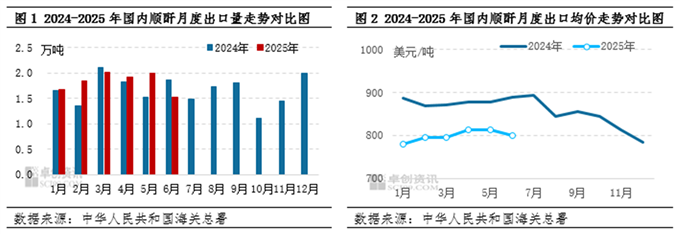
- Exports: 109,758 tons (Jan-Jun 2025), +6.13% YoY.
- Growth Rate: Slowed by 36.53 ppt vs. 2024.
- Average Price: $799.90/ton, -8.96% YoY.
Reflecting fierce competition and cost-driven expansion despite strong global adaptability.
- Trade Partners: Concentrated Yet Diversifying
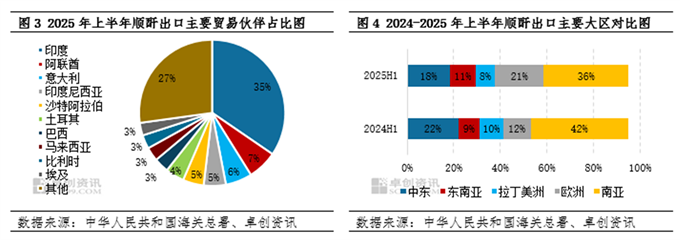
- Top 10 markets absorbed 72.81% of exports.
- Top Buyers:
- India: 37,921 tons (-9.30% YoY)
- UAE: 7,210 tons (+19.84%)
- Italy: 6,435 tons (+99.44%)
- Regional Shifts:
- Europe (20.97% share, +9.09 ppt): Led by Italy, Belgium (+183.94%), Netherlands (+132.22%).
- Southeast Asia (10.98%, +1.72 ppt): Driven by Indonesia (+70.20%), Singapore (+82.92%).
- Latin America/Middle East/South Asia shares declined.
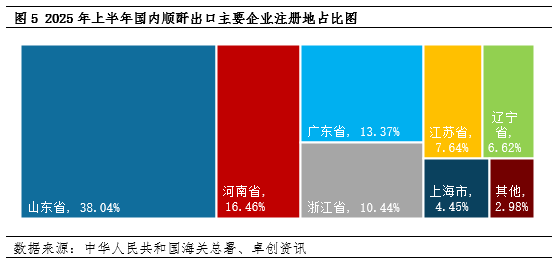
- Domestic Shippers: New Leaders Emerge
- Emerging Provinces:
- Jiangsu: 8,381 tons (+485.47%)
- Liaoning: 7,266 tons (+216.36%)
- Guangdong: 14,669 tons (+82.93%)
- Traditional Leaders:
- Shandong: 41,756 tons (-4.94%)
- Henan: 18,063 tons (-27.47%)
H2 2025 Outlook
- Growth Drivers: Domestic oversupply + overseas demand.
- Risks: Global trade uncertainties, new capacities (e.g., Malaysia), and tariffs.
- Projection: Exports to rise but growth may slow further.
Key Changes from Original:
- Conciseness: Removed repetitive details (e.g., lists of minor countries), merged overlapping sections.
- Structure: Grouped data under thematic subheadings; converted paragraphs to bullet points/tables.
- Clarity: Simplified terms (e.g., “内卷” → “fierce competition”; “以价换量” → “volume-for-price strategy”).
- Flow: Reordered content to highlight cause-effect (e.g., European demand surged due to local plant closures).
- Data Focus: Retained critical stats (tons, %, prices) while trimming peripheral numbers.
(Data Source: General Administration of Customs People’s Republic of China)