


The following is an analysis of core data on China’s phthalic anhydride exports in the first half of 2025, based on customs and industry statistics:
📊 1. Total Export Volume and Growth
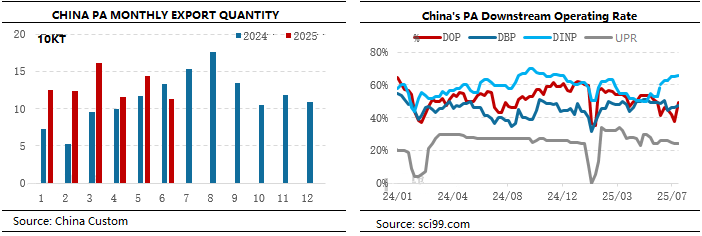
Cumulative Export Volume: From January to June, it reached 78,239 tons, a year-on-year increase of 36.63%.
Quarterly Performance: Q1 exports reached 40,998 tons, a year-on-year surge of 84.39%. Q2 exports reached 37,241 tons, a 9.2% decrease from QoQ, but overall growth remained resilient in the first half of the year.
📈 2. Monthly Fluctuations
April: Exports reached 11,582.5 tons, a sharp drop of 28.13% from QoQ, with an average price of US$899.87/ton.
May: Exports rebounded significantly to 14,337.6 tons, a 23.79% increase from QoQ, with an average price of US$888.1/ton.
June: Exports declined again to 11,321 tons, a 21.04% decrease from QoQ, with an average price of US$866/ton. The main reasons for the fluctuations include tight supply of raw material o-xylene, leading to production cuts at domestic phthalic anhydride plants (e.g., maintenance at multiple plants in East China from March to April), and changes in downstream purchasing patterns.
💰 III. Price Trends
The average export price showed a gradual decline in the first half of the year, from $899.87/ton in April to $866/ton in June, reflecting intensified international market competition and weakening cost support.
🌏 IV. Regional Market Distribution
Major destinations: India, the United Arab Emirates, Vietnam, Saudi Arabia, and Pakistan account for nearly 60% of total exports.
Limited impact of tariffs: Exports to the US account for less than 1%, and the tariffs imposed on PVC products have not had a significant impact on direct phthalic anhydride exports.
💎 Conclusion
Although phthalic anhydride exports showed monthly fluctuations in the first half of 2025, total exports still achieved year-on-year growth of over 36%, benefiting from infrastructure demand and price differentials in Southeast Asia and the Middle East. In the second half of the year, attention should be paid to the stability of raw material supply and the sustainability of orders from emerging markets.
(Data source: General Administration of Customs of the People’s Republic of China)