China Phthalic Anhydride (PA) Market Analysis (First Half of 2025)
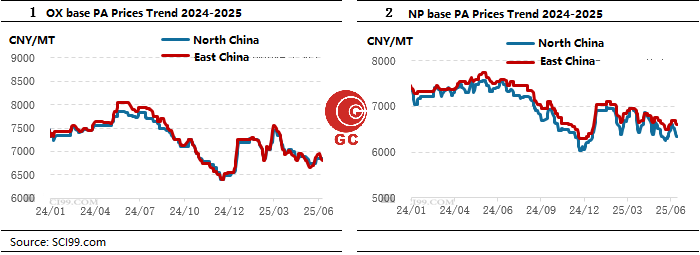
[Introduction] In the first half of 2025, the overall market price of phthalic anhydride showed an “M”-shaped trend, with a year-on-year decline. As of now, taking the East China ortho-phthalic anhydride market as an example, the average market price from January to June was 7,033 yuan/ton, a year-on-year decrease of 7.85%, and the price fluctuation range was 6,500-7,600 yuan/ton. In the second half of the year, it is expected that the market price of phthalic anhydride may fluctuate downward, and the price center of gravity may move downward compared with the first half of the year, but the amplitude may be limited.
1. Supply-Demand Dynamics
In the first half of 2025, China’s PA market exhibited a supply-heavy, demand-weak pattern. On the supply side, domestic PA capacity continued to expand, with new plants such as Fujian Fuhua Gulei Chemical’s 180,000-ton/year facility coming online, boosting production. Meanwhile, downstream demand remained sluggish, particularly in the plasticizer (DOP) sector, where low operating rates led to PA inventory buildup and price pressure.
2. Price Trends
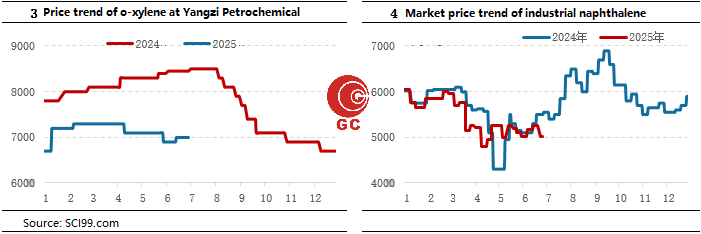
The price of phthalic anhydride first rose and then fell, showing a fluctuating downward trend:
Jan-Feb: A brief rebound occurred due to post-holiday restocking and rising feedstock orthoxylene (OX) costs, with prices for OX-based PA in East China peaking at ¥7,300/ton.
Mar-Apr: As supply recovered while end-user demand (e.g., plastics, coatings) lagged, prices retreated to around ¥7,100/ton, down ~3.8%.
May-Jun: The market weakened further, with OX-based PA prices in Jiangsu dropping to ¥6,700-6,900/ton, driven by weak plasticizer demand and insufficient support from plant maintenance shutdowns.
3. Industry Challenges
Overcapacity Risks: Domestic PA capacity grew at an annualized 0.7%, but demand growth fell short, potentially exacerbating oversupply.
Environmental Pressures: Stricter green chemical policies are pushing firms to invest in sustainability, with bio-based PA emerging as a future focus.
4. Outlook
Short-term, the PA market will likely remain range-bound at low levels due to high supply and tepid demand. Key factors for H2 include:
Demand recovery in downstream sectors (e.g., new energy, electronics).
Whether export markets can alleviate domestic oversupply.
In summary, H1 2025 saw a subdued PA market, with H2 expected to remain in adjustment mode. Producers must optimize capacity structures to stay competitive.